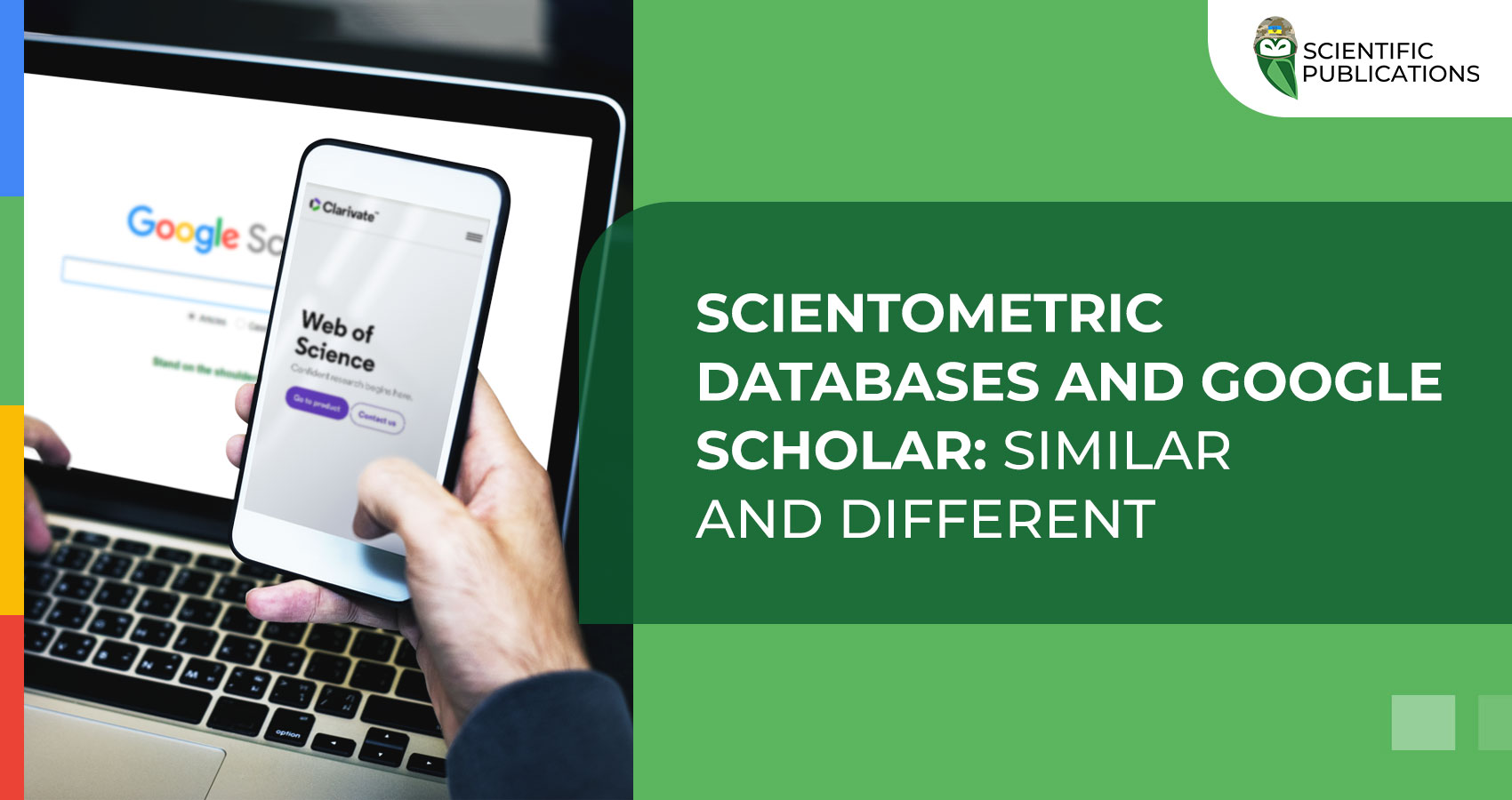
Scopus, Web of Science, and Google Scholar are the most influential services in the scientometric world. The first two are considered international databases, while the latter is more of a scientometric platform, often misunderstood as a former category. As such, to prevent confusion, we will analyze what is similar and different within the platforms and what are their specifics, and what to remember while working with them by key categories.
Author’s profile creation
All three services: Scopus, Web of Science, and Google Scholar create a personal author’s profile and register the digital author’s identifier. However, the author's creations are done differently.
Scopus: To create the author’s profile in Scopus and get Scopus ID, it is necessary to publish at least one scientific article in the magazine, indexed by the scientometrics database. After its indexation, the author's profile is created, while its final configuration is done after a second scientific article publication.
Web of Science: author’s profile creation and Researcher ID creation can be done without any publications in the magazines, indexed by the scientometrics database. However, in this case, the expanded analytics on main metrics will not be available.
Google Scholar: author's profile can be created regardless of the number of scientific publications. During the author's profile creation, the author enters the contact information and then adds all his works, present on the Internet. As such, the researcher gets his Google Scholar ID and main scientometrics metrics analytics in the personal profile.
Material search algorithms and their representation
Scopus and Web of Science: own scientific materials are added automatically after their indexation in the database. To find other scientific works, a subscription is needed. Search by author, and scientific institution is available for free access, while Scopus also has a search by magazine.
Google Scholar: addition of own scientific materials into the author's profile is possible manually. In some regard, it is not an ideal algorithm as it does not require proof of authorship. As such, either by accident or with intent to artificially improve metrics, other works by similar last names or other authors, etc. may be added. Search is done similarly to Google. Keywords are entered in the search bar and relevant search results are then shown. By following the links the user is directed to the site of published material. It is sometimes possible to directly download the works straight from the search result window. All search types, including expanded ones, do not require a subscription. However, to view the closed-access materials, a fee may be required. This is a normal exception for all scientometrics platforms.
Scientific materials specifics
Scopus and Web of Science: the international databases contain materials that have been peer-reviewed in the ranking scientific journals indexed in Scopus and Web of Science. Database specialists actively monitor the quality of journals and their contents. The largest share of scientific materials is written in English, but there is also a small percentage of materials made in other languages. By type of content, scientific articles, as well as books and conference proceedings are leading.
Google Scholar: the system supports all materials posted on the Internet. Sometimes within the service, it is possible to find "non-scientific" sources with no peer review or pre-moderation of content, which creates some risks for scientists. The material is posted in both English and regional languages. The service supports various kinds of content: monographs, textbooks, articles, conference abstracts, etc.
Resource ecosystems
Scopus: is part of the global network of Elsevier, which covers such services as Mendeley, SciVal, ScienceDirect, and others.
Web of Science: belongs to Clarivate products and is connected with InCite, EndNote, JCR, and others.
Google Scholar: related to Google products.
Scientometric metrics of the author
The main scientometric metrics within Scopus, Web of Science, and Google Scholar are the citation index and the Hirsch index. In general, it can be said that scientometric databases provide more opportunities for analyzing the scientist's indicators, such as graphical display of metrics, adaptation by years, topics, impact, etc. Within Google Scholar, an additional metric i10-index is calculated.
Platform functionality
Despite all the differences, the functionality of Scopus, Web of Science, and Google Scholar are similar. Various types of search, tracking materials, their analysis, saving, selection of publications for publication, etc. are present. However, the scope of use of these features is largely related to the specifics of the services.
Comparative characteristics: Scopus and Web of Science vs. Google Scholar
|
Functions |
Scopus, Web of Science |
Google Scholar |
|
Usage fee |
If you use the full version, you need to subscribe, there are free versions with limited features. |
Free |
|
Registration on the platform |
The profile is formed at the first publication (for Scopus) Registration in Web of Science is possible even without publications |
Registration is possible without publications |
|
Adding materials |
Automatically (sometimes manually) |
Manually (with selection of relevant publications or full addition of material details) |
|
Material Search |
Within the base itself. |
On the Internet |
|
Ability to use as a bibliographic manager |
Yes, with a basic set of functions |
Yes, with a basic set of functions |
|
Possibility to use for selection of a publication |
Got it |
Got it |
|
Reviewing or moderation |
Yes, it's ongoing |
Virtually none |
|
Author's scientific metrics |
Citation index, Hirsch index |
Citation index, Hirsch index, i10-index |
|
Opportunity for deeper analytics |
Got it |
Virtually none |
|
Platform openness |
Relied upon in materials that are indexed only within the databases themselves |
Material coverage - the entire webspace |
|
Related services |
The entire Elsevier or Clarivate ecosystem |
Linked to Google services |
|
Indexed materials |
Predominantly scientific articles, conference proceedings, books |
All types of scientific materials |
|
Writing language |
Predominantly English, a small part in national languages |
Supports almost all national languages |
"Scientific Publications" company provides deep analytical work on the scientometrics platform usage and their specifics. We provide services on “Scopus publications”, “Web of Science publications”, "Google Scholar citations" and others to fully cover researcher needs and support the sphere of science.
Leave a request on our website and our experts will contact You as soon as possible!