


“How to make a publication in Scopus? How to write an article in Scopus?”, - these questions are of interest to literally thousands of scientists. Today we will explain where to look for answers to these questions and will provide efficient tips to pay attention to when planning a publication in Scopus: from the moment of a scientific hypothesis formation to the indexation of an article.
Stage 1. Scientific hypothesis: preparation for the Scopus publication
Stage 2. Research and scientific analytics
Stage 4. Citation and bibliography
Stage 5. Metadata of a scientific article
Stage 6. Translation into academic English
Stage 7. Choosing a journal for the publication
Step 8. Ethics of scientific publications
Stage 9. Communication with representatives of scientific journals
Stage 10. Indexation of a scientific article
The role of the intermediary company in the publication process

Stage 1. Scientific hypothesis: preparation for the Scopus publication
Before writing an article for Scopus, a scholar needs to form a scientific hypothesis, which will be approved or disproved in the course of the work. This stage plays a strategic role in the research. It is worth pointing out that a scientific hypothesis should not contradict the major scientific facts, however it should determine previously unexplored or poorly researched aspects of a particular issue.
At the planning stage, a scientific hypothesis may not yet be fully formed and may serve more as an assumption. Its ultimate version is formed by the scholar after the analytics, described in Stage 2 of this guide.
Creating a qualitative scientific hypothesis becomes the first step in answering the question: how to publish an article in Scopus.
Stage 2. Research and scientific analytics
At this stage, the researcher should conduct in-depth analytics in order to determine the poorly - researched aspects of their subject area, discipline of knowledge and areas of scientific interest. The Scopus , Web of Science scientometric databases, and the Google Scholar platform are rather convenient to be used for this purpose.
For this, there is a version of the basic and advanced search on the platforms. Here we provide some tips for optimising your search capabilities:
- If you are not fully aware of which authors work on your research topic and in which journals they publish, use the search by topic, keywords.
- If you are targeting some authors, explore by a researcher and study the works of specific scholars.
- If you are interested in placing a publication in a particular edition, then perform the search in a scientific journal and study the specifics of the works published there.
- It is worth mentioning that a considerable number of publications is placed under the traditional access business model, including the payment by the reader. There is a free of charge option to view the works published in Open Access.
- Advanced search should be applied to form highly specialised queries, however without a subscription it can only be used with Google Scholar.
Obviously, for researchers who are concerned about an article publishing in Scopus, first of all, it is necessary to study the scientific articles posted within this database. With free of charge access, search capabilities are provided with regard to an author and a cientific publication. With a subscription, any type of search is available.
In Web of Science, only authors’ profiles are available at no charge. With a subscription, any type of search is available.
The Google Scholar features provide a no charge access to any search feature, with a fee only if the researcher wishes to get familiar with how traditional access works.
Features of search capabilities in Scopus, Web of Science and Google Scholar:
|
|
Scopus |
Web of Science |
Google Scholar |
|
Free of charge version |
Search by author, scientific journal. |
Opportunity to get acquainted with the profile of the author and view the list of their publications. |
Search for scientific articles and advanced search, including information about the author, scientific journal, period of publication, the ability to form a highly specialised query. |
|
Subscription to a resource |
Search by publications, author of publication, edition, scientific organisation. Additionally, advanced search options are provided. |
Search by publications, author of publication, edition, scientific organisation. Additionally, advanced search options are provided. |
There is no subscription version, payment may be charged if the researcher wishes to get acquainted with the works posted in the traditional way of access. |
One should familiarise with at least 100 papers on the topic of their future research.
Stage 3. IMRAD Structure
The further step in answering the question of how to publish an article in Scopus is to comply with the IMRAD structure when formatting the text of the work. When a scholar already has a scientific hypothesis and they have determined the research degree on their topic, they may start working upon the text formatting of a scientific article. The mandatory reference structure in this situation is IMRAD, where “I” stands for Introduction, “M” - Materials/Methods, “R” is Results and “D is Discussion. Let us introduce each of them in further detail.
Introduction
This structural element is an introduction to your study, it briefly describes what the work is about, defines the main regulations and tasks. It is the element of a scientific article that should describe why this article is essential for the international scientific community.
Materials/Methods
This part of the paper describes the research process so that it can be reviewed if necessary. A significant aspect at this stage is the understanding of whether the study is theoretical or experimental.
Results
The research results section is self-explanatory. Here the author describes what exactly was obtained as a result of the work. This part welcomes the application of graphs, tables, charts and other illustrative materials. The author may touch upon the purpose, methodology and describe the challenges in the research process.
Discussion
In this section, the author provides an assessment of the results obtained and explains them. The strengths and weaknesses of the study should be pointed out and comparison should be held with the works of other researchers.
In addition to following the IMRAD structure, observe the quality of implementation of the following aspects:
- Layout of tables, graphs and charts. Knowledge of MS Word, Adobe Illustrator, Corel Draw will be useful for this.
- Image quality (300 dpi extension).
- Convert formulas to LATEX format.
- Having a brief summary in the conclusion format.
- Remember about essential details: the use of dashes and hyphens, extra indentation, separating the last name and initials.
Basic tips for writing the text of a scientific article

Following these pieces of advice will significantly improve your chances of getting published successfully in Scopus.
Stage 4. Citation and bibliography
An obligatory element in writing a paper and in answering the question of how to publish in Scopus is mentioning of the works of other researchers in the paper, a detailed analysis of which is carried out at Stage 2 of this guide. All references to other authors and works are supposed to be properly arranged in the form of citations and bibliography.
Appropriate citation and bibliography contribute to:
- Familiarisation with the most relevant sources on the topic.
- Conducting a more thorough literature review, and, and as a consequence, more qualitative scientific research.
- Reinforcement of the theses and arguments given in the article.
- Avoiding academic plagiarism, since improper citation equates to academic dishonesty and reduces the uniqueness of the work.
When designing such elements of the work, one should rely upon the citation style used in the journal where the article is submitted. There are around 10-15 most common styles; most commonly used ones are as follows:
- Vancouver
- Council of Biology Editors
- MLA
- Harvard
- Chicago
- NLM
- APA
Below there are the peculiarities of the bibliography layout for each of them:

Citation in the text occurs in square and round brackets. In the first case, the sources are placed in the order indicated in the text, in the second - by the names of the authors, then the list of exploited sources is built in an alphabetical order.
Stage 5. Metadata of a scientific article
The metadata of a scientific article is the smallest element of a scientific work in terms of volume, but not in terms of significance. It includes an abstract, a title and keywords. Metadata are required not only to answer the question of how to make a publication in Scopus, but also to better popularise a scientific article.
Now, let us consider the peculiarities of each of them.
Abstract
It is a structural element, which introduces a scientific article to reviewers, the journal editorial board, and potential readers. It should maintain a clear structure, including a summary of objectives, methods, major results, as well as relevance and recommendations. At that, in the structural element there should be no references to other authors. The average abstract length contains from 150 to 300 words.
Checklist of a qualitative abstract

The work title
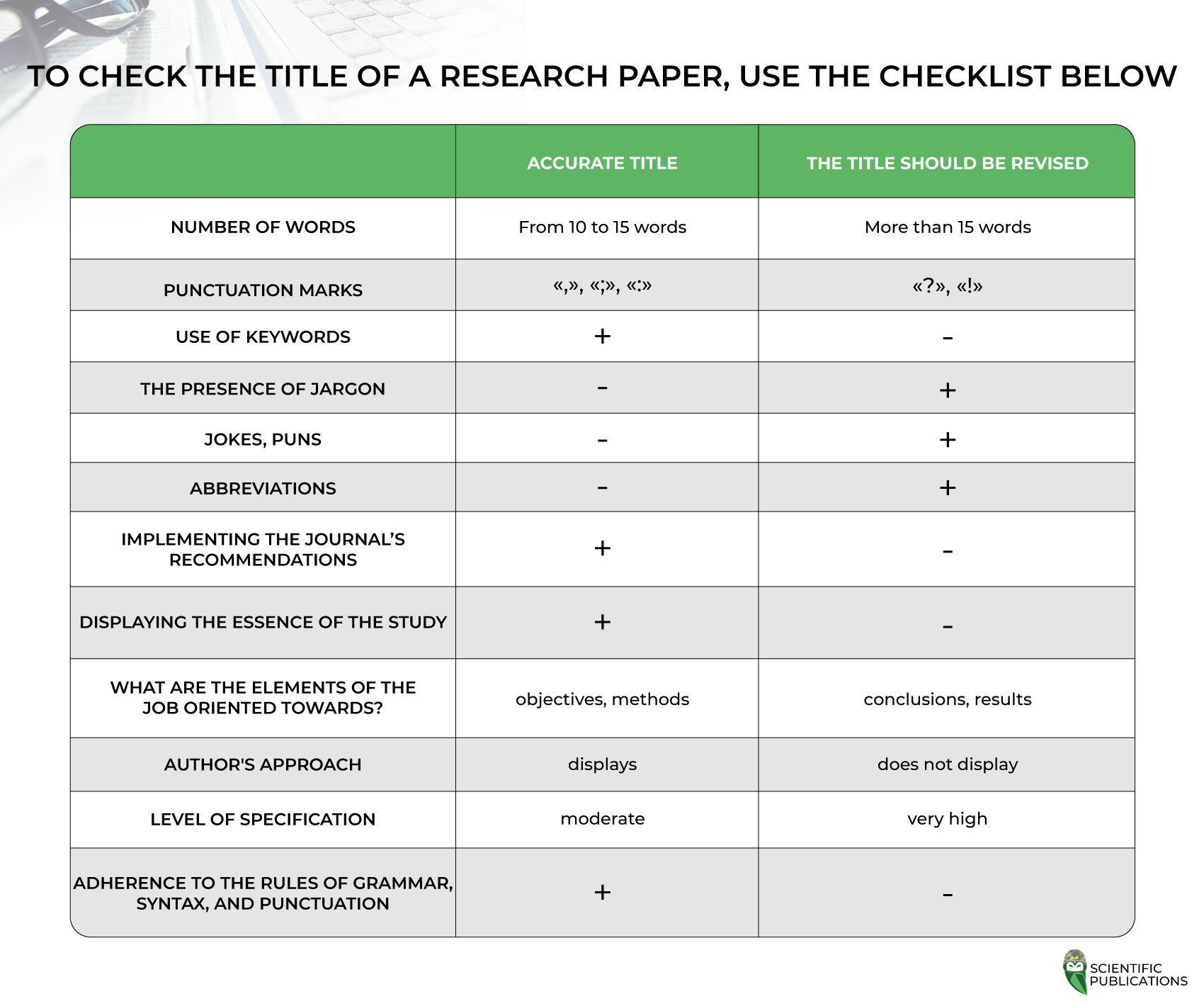
The title of the work is literally its trademark. It should attract interest of the audience and at the same time be comprehensible and concise. The perfect title is supposed to include no more than 10-15 words. Highly specialised contractions should not be applied in the title of the work; this structural element is most often connected with the objectives and objects of researches.
Checklist for the checking of the title of a scientific article
Keywords
Keywords are not just a set of words related to a topic. Based upon them, readers will form search queries, which will contribute to, or hinder the increase in scientometric indicators. Keywords should not duplicate the name of the work, as well as accurately reflect the topic, objective of the work and the specifics of the study. As a rule, there are from 4 to 6 keywords.
High-quality writing of these structural elements will increase citation, the H-index and other scientometric indicators. This is the next thing a scientist needs to take care of after publishing an article in Scopus.
Stage 6. Translation into academic English
This stage is one of the most essential ones in answering the question of how to publish an article in Scopus. Poor-quality academic translation may damage even a potentially high-rated scientific work. In this case, there are risks that the reviewers and the editorial board simply will not understand the author's opinion embedded in the text of the article.
Surely, the author may also submit their scientific article to a journal that is not published in English, but in any other regional language. However, the share of such publications in the Scopus scientometric database is much smaller than those that publish materials in English.
When translating independently, one should keep a few essential things in mind:
- Avoid machine translation, and accurately apply subject terminology since a scientific work should be characterised by a high-quality academic language.
- Pay attention to style and grammar.
- Expand your vocabulary, each word must be accurately chosen and contain single interpretation.
- Monitor the accuracy of the facts described.
- Pay attention to structure of sentences and work on optimising their length.
- Use grammar checking services, helping you avoid common mistakes.
To better understand the peculiarities of academic translation and avoid mistakes at this stage of work, feel free to watch the topical video:
Stage 7. Choosing a journal for the publication
Choosing the journal is a significant point in answering the question of how to publish an article in Scopus. Just placing the work in the publication is not enough, it is worth finding the most suitable and high-quality one. For this we recommend to:
- Consider the quartile and percentile regulatory indicators you need. Perform a search in the database.
- Assess journals from the required area of scientific research, discipline, subject area. Additionaly, it is useful to review the publications where the works reviewed in Stage 2 of this guide were published.
- Study the websites of the most relevant journals and critically reflect on all the information posted there.
- Check the indexation of the selected journals, compare with the information posted on the website of the publications. A respectable publication will have the specified information matching.
- Analyse publication activity and thematic areas, which the journal covers.
- Choose one major publication and several as a reserve. Prepare the manuscript for submission to the journal, which is the main option. In case of rejection, promptly prepare the article for submission to one of the “reserve” options.
Journal Finder: assistance with choosing a scientific journal for publishing in Scopus
Journal Finder assist one in choosing a scientific journal for publication in Scopus. Almost all of the most influential publishing companies offer such services, as well as various scientometric resources. Since at the present stage of scientometrics development there is a considerable amount of Journal Finder, we will briefly consider the principles of operation of some of them.
It should be noted that this will help scholars minimise the time for compiling a list of the most suitable journals for publication in Scopus. However, this does not mean that the stage of analytics may be neglected, because the Journal Finder is an automated resource,using the algorithms embedded in it. The researcher needs to critically comprehend and analyse all publications selected this way.
Elsevier Journal Finder
Springer Journal Suggester
Taylor & Francis Journal Suggester
Unscrupulous publication: ways of identification?
Unfortunately, publications that conduct unscrupulous or openly fraudulent performance, are also indexed in the Scopus scientometric database. Surely, Elsevier specialists are constantly monitoring the activity of publications and attempt to immediately terminate their indexation.
However, situations often occur when a researcher who follows a particular scientific journal, is sure of its trustworthiness, but at a certain time the journal starts violating publication ethics. The author, previously convinced of the quality of the publication, sends a scientific article there, however the journal is no longer indexed in the database. Eventually, there are wasted time, funds and the need to prepare the manuscript for publication again.
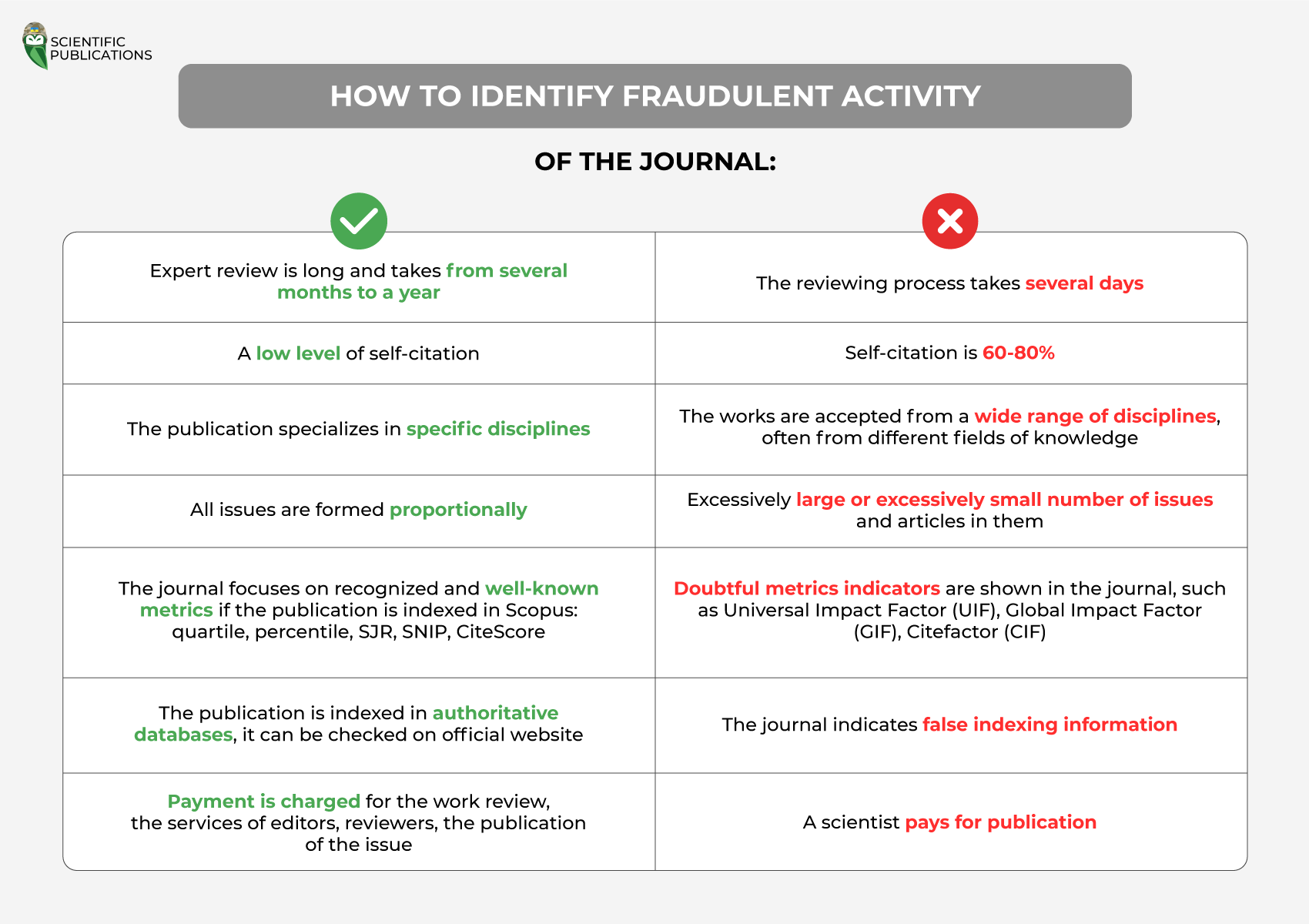
In order to protect oneself from unscrupulous scientific journals, let us consider their typological features:
- Predatory journal – the publication starts having indexation in the Scopus database, and then accepts any work until it is excluded from the database.
- Clone publication – a journal, completely copying the information of an original publication; the one that begins accepting scientific articles on its behalf. Obviously, an original journal and the scientific community are attempting to identify and terminate the activity of such a journal as soon as possible. However, in some cases, scammers even manage to index some articles in Scopus.
- Fake magazine – scammers create a website for a non-existent journal. One can detect such manipulation by checking the indexation in the Scopus database.
In order not to fall into the trap of unscrupulous scientific publications, one should pay attention to several fundamentally essential points:
How to publish an article in Scopus at no charge?
One should be aware of the fact that there is no way to publish an article in Scopus for free, in any case there must be a source of funding, that being an author, a reader,a sponsor or an advertiser. And it directly depends on the business model of a scientific journal. Previously we considered, using a specific example, which options exist for publishing a scientific article without authors’ payment.
However, let us briefly recall the main characteristics of various business models of scientific publications:
|
Business model |
Peculiarities |
|
Traditional model |
This type of access implies the publishing fee to be charged to the readers, not the author. It is common when libraries form their own exclusive collections based upon subscriptions to certain scientific journals. Thus their readers are able to view the materials without independent payment. However, as statistics show, such works have 95% less citation rates. |
|
Open Access |
According to this type of access, the author pays a publication fee. This business model corresponds to the modern trend of open science, using which publications gain higher scientometric indicators. There is Gold, Bronze, Green and Platinum Open Access defining various payment options. |
|
Hybrid access |
Combines two models, mentioned above. |
|
Sponsorship and advertising |
Special types of business models meaning payment by sponsors or advertisers (third party). |
As you can see, the choice of a scientific journal is a very multicomponent process, however, all the above-mentioned details are essential in answering the question of how to make a publication in Scopus.
Step 8. Ethics of scientific publications
So, at this stage, the scientific article has already been written, the journal for publication has been selected - it is time to submit the article. In fact, most of the way has already been passed before publishing an article in Scopus.
However, we wish to remind you of several rules for following the ethics of scientific publications. We ask researchers not to abuse any of them. Since this will not only lead to the fact that the article will not be published in Scopus, but will also affect the reputation of the researcher.
Please consider:
- The level of uniqueness of the work. Plagiarism, incorrect quoting, borrowing and appropriation of ideas are not allowed.
- Exploitation of illustrative materials not of one's own authorship (only with the permission of the copyright holder).
- Presentation of the scientific work in several scientific journals at once. A scientific article should be submitted only to one journal, and in case of refusal a manuscript needs to be prepared for another journal.
- The similarity of the author's work with their previous works, republishing of the same work is unacceptable.
Without following the above-mentioned principles, publication in Scopus is not possible.
Stage 9. Communication with representatives of scientific journals
It should be noted that in the case when a researcher questions themselves how to publish an article in Scopus, they must be ready to communicate with representatives of a scientific journal. It is often held in English.
Remember, the task of reviewers and the editorial board is not to criticise your research, but to improve it. Therefore, heed the comments and correct the flaws pointed out by representatives of scientific journals. Surely, if a certain remark, in your opinion, is unacceptable, make an attempt to convey it to reviewers and editors.
Also the method of payment is worth considering. Thoroughly investigate the payment systems or the peculiarities of the functioning of the financial institutions where you send funds (obviously, if this is required by the chosen business model of the journal).
Stage 10. Indexation of a scientific article
In case of successful completion of each of the nine stages presented above, the researcher will receive a complete answer to the question of how to publish an article in Scopus. However, another essential stage is worth recalling - the indexation of a scientific work.
Indexation is a purely technical process of entering information into the Scopus database. It does not require the activity of the author, but takes place within the journal and the scientometric database. Acceptance of a scientific article and its publication in a journal of the Scopus base means its indexation. However, if this process did not start within a few months and information about the article did not appear in the author's profile, the scholar should contact the representatives of the scientific journal and the Scopus scientometric database. They will assist with figuring out exactly where the error occurred and how to solve it.
The role of the intermediary company in the publication process
We know how complex the answer to the question of how to publish an article in Scopus is and how many factors it depends on. Within the scope of this material, we have mentioned just the most important of them, however, there are a lot of details that simply cannot be described within one article.
For this reason the sphere of scientific and publication consulting is becoming increasingly vital. The company “Scientific Publications” cooperates with researchers at all the above stages.
Working with us includes:
- Audit of scientific material.
- Work structuring.
- Editing and design of the text of the article.
- Academic translation and proofreading.
- Selection of a scientific journal in accordance with the scientific objectives of the scholar.
- Communication with representatives of scientific journals.
- A personal manager support by the time the article is indexed.
- Informing about a status change of work.
Choose the “Publishing in Scopus” service on our website and a personal manager will contact you as soon as possible to provide all possible conditions for cooperation.


