The order of authors in a scientific paper is not a formality but a reflection of the genuine contribution made by each participant in the research. A scientist's reputation, citation rate and the confidence of the journal's editorial board all depend on how correctly the positions in the author list are assigned and the functions of co-authors described. Mistakes at this stage frequently lead to conflicts within a team and even to the retraction of a publication.
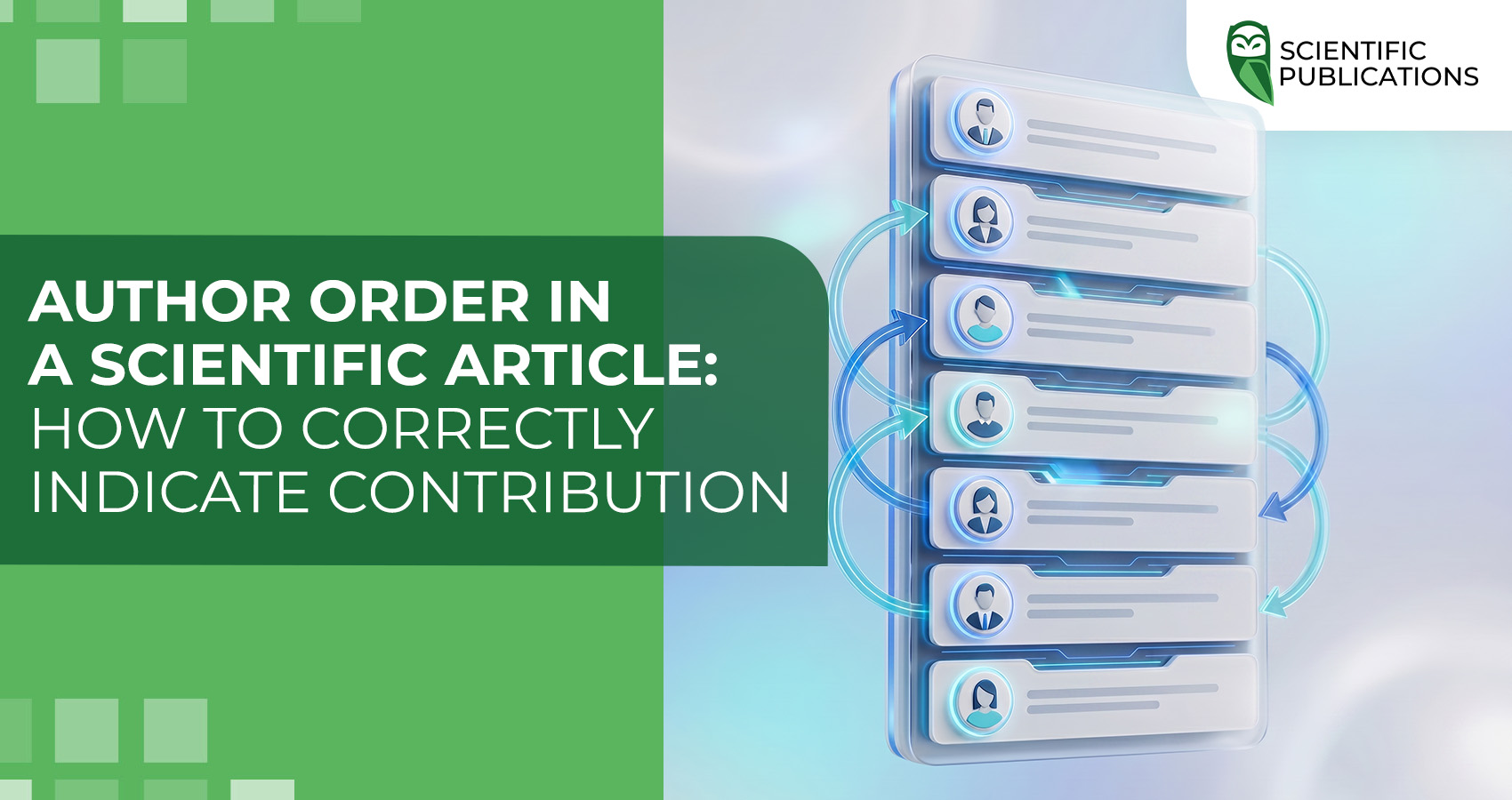
Determining the order of authors in a scientific paper
In most scientific disciplines, an author's position in the list corresponds to the volume of their contribution to the work. The first author usually carries out the main part of the research – planning the experiments, gathering and processing the data, and preparing the draft manuscript. The final position is traditionally reserved for the head of the team or the leading scientist under whose guidance the work was conducted.
If a candidate's papers are written in co-authorship, they must objectively reflect the contribution of each co-author and obtain written consent for these papers to be used in the dissertation; such consent is attached to the qualification documents. The distribution of roles and the order of authors should therefore be fixed in advance, while work on the joint publications is still under way.
Who can be considered an author of a scientific publication?
Not everyone who helped with the work has the right to authorship. The International Committee of Medical Journal Editors (ICMJE) has formulated four criteria, and an author must satisfy all of them at once. Authorship is based on a substantial contribution to the conception or design of the work, or to the collection, analysis or interpretation of the data. The full list of conditions is as follows:
- substantial contribution to the conception, design, collection or interpretation of the data
- participation in drafting the text or revising it critically
- approval of the final version before publication
- willingness to take responsibility for all aspects of the work
Those who do not meet all four criteria should be acknowledged in the acknowledgements section. This applies, for example, to staff who provided technical support or funding but took no part in the research itself.
How should each author's contribution be described?
Modern journals require not merely a list of names but a statement of the specific functions of co-authors. The CRediT (Contributor Roles Taxonomy) is used for this purpose. According to CRediT, there are fourteen roles that a participant may perform within a piece of research. These include conceptualisation, methodology, formal analysis, conducting the experiment, drafting the original text and editing.
The system was developed with a specific aim. CRediT was introduced to recognise the individual contribution of authors, reduce the number of authorship disputes and facilitate collaboration. Today many publishers make such a description a mandatory condition for submitting a manuscript.
Why fix contribution in advance?
Disputes over the order of authors most often arise once the work is already complete, when little can be changed. To avoid this, the contribution of participants should be documented throughout the project. The following sequence of steps is recommended:
- Discuss the distribution of roles before the research begins.
- Record the specific tasks of each participant as the work proceeds.
- Agree the final list and the order of authors before submitting the manuscript.
- Obtain written confirmation from all co-authors.
This approach protects the team from misunderstandings. A contribution statement completed under CRediT effectively serves as a document that records who did what – and it is often the only proof available when a dispute over authorship arises.
Equal contribution and collective authorship
Sometimes two or more scientists make an equal contribution. In this case journals permit a note of equal authorship with an appropriate annotation. For large international projects, collective authorship is used, where the work is published under the name of a consortium and the names of the participants are given in a separate list. Even so, each member of the group must still meet the ICMJE criteria.
It should be noted separately that artificial intelligence tools are not listed as authors, since they are unable to take responsibility for the content of the work, although their use is permitted provided that it is disclosed.
Correct author order and a transparent description of contribution form the basis of academic ethics and mutual trust within a research team. Applying the ICMJE criteria and the CRediT taxonomy helps to distribute recognition fairly, reduce the risk of conflicts and raise the quality of a publication in the eyes of the editorial board. Resolving these matters at an early stage of the work saves time and preserves the working relationships between co-authors.
Are you preparing an article for publication and wish to attribute authorship and metadata correctly? The specialists at Scientific Publications will help you prepare your manuscript, select a journal in the Scopus or Web of Science database, and support your work through to successful publication and indexing. To receive a free consultation, fill in the form below and our manager will contact you shortly. Onward to new scientific achievements!