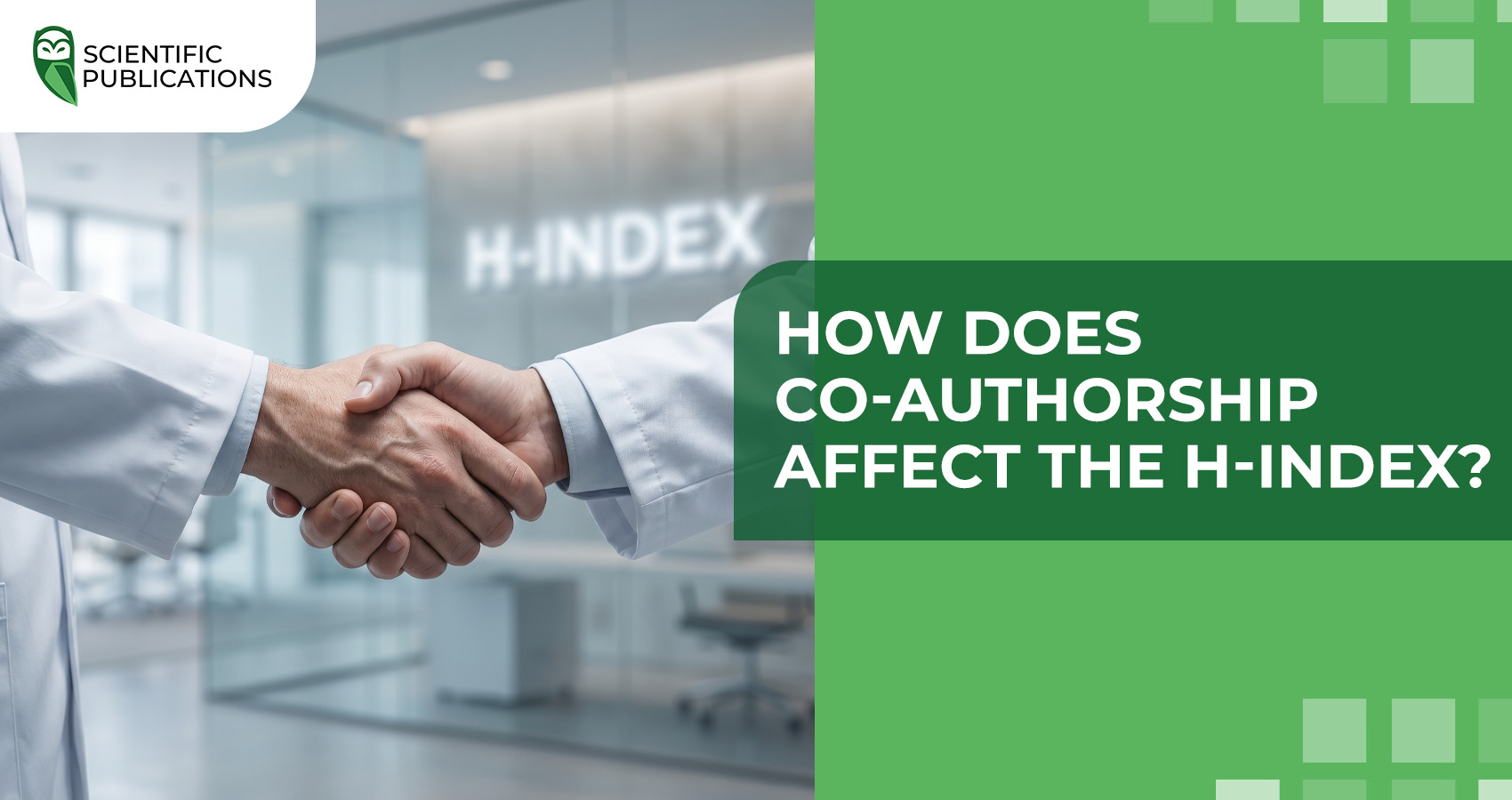
The h-index remains one of the most widely used measures for assessing a researcher's scholarly productivity and citation record. When preparing to defend a dissertation, competing for grants or building an academic portfolio, it is often treated as one of the key reference points. Modern science is increasingly collective in character, and the share of papers written in co-authorship continues to grow.
The effect of co-authorship on the number of publications and citations
Under the standard calculation model, a joint paper is credited to each co-author in full, regardless of their actual contribution and their position in the author list. This means that taking part in collaborative research can influence the h-index along several lines at once:
- A rise in the number of publications. Working jointly allows you to take part in more studies over the same period, which expands the author's overall body of publications.
- Higher citation rates. Papers prepared by several authors often reach a wider audience thanks to overlapping research networks and mutual references.
- Broader thematic coverage. Collaborating with specialists from adjacent fields opens up access to new directions and journals, which may also be reflected in citation rates.
In this way, all else being equal, co-authorship often contributes to the growth of the h-index. That said, this effect should not be regarded as automatic: it depends on the quality of the work and its demand within the research community.
Why co-authorship can inflate the h-index?
The main criticism of the h-index relates precisely to the fact that it does not distinguish the real contribution of individual authors. A paper written by two researchers and a work involving several dozen co-authors are credited to each of them equally. In fields where so-called hyperauthorship is common – publications with hundreds of participants, as is typical, for example, of high-energy physics, genomics and large clinical trials – this can noticeably distort individual figures.
A further factor is the practice of mutual citation and self-citation within established research teams. When members of one group regularly reference their joint work, citation rates grow not so much through external recognition as through the internal activity of the network. For this reason the h-index, taken in isolation from other data, does not always give an accurate picture of a researcher's independent contribution.
How to assess the h-index correctly when there are co-authors?
When interpreting the h-index, it is sensible to take the context into account and not to confine yourself to a single numerical value. A fuller picture is given by a combination of factors:
- The research field – the co-authorship practice typical of the discipline and the citation norms accepted in it, which determine the indicator's characteristic values.
- The author's role in publications – the share of work carried out as first or corresponding author, reflecting the degree of their involvement in the research.
- A combination of metrics – considering several scientometric indicators at once rather than relying on a single value.
Such an approach reduces the risk of over- or under-estimating the real scholarly contribution that can arise when relying solely on one numerical value.
Co-authorship has a noticeable but ambiguous effect on the h-index. On the one hand, joint publications can increase the number of works and their citation rates, contributing to the growth of the indicator.
On the other, the standard calculation method does not account for the actual contribution of each participant, which in certain cases leads to the inflation of individual figures. Understanding these features makes it possible to interpret scientometric data more accurately and to make well-founded decisions when planning a publication strategy.
Would you like to raise your h-index? Scientific Publications is ready to help. Our specialists will audit your profile and develop a tailored strategy for improving the figure. Fill in the form below and our manager will be in touch shortly. Together, towards new scientific achievements!