


Participation in conferences is often seen as a convenient and fast way to obtain a publication indexed in Scopus. However, behind the apparent similarity of the formats lies a significant difference in the way materials are selected, the depth of peer review, and the later fate of the paper. Conference proceedings can be a useful addition to an academic portfolio, but they cannot fully replace a journal article. We explain why in article.
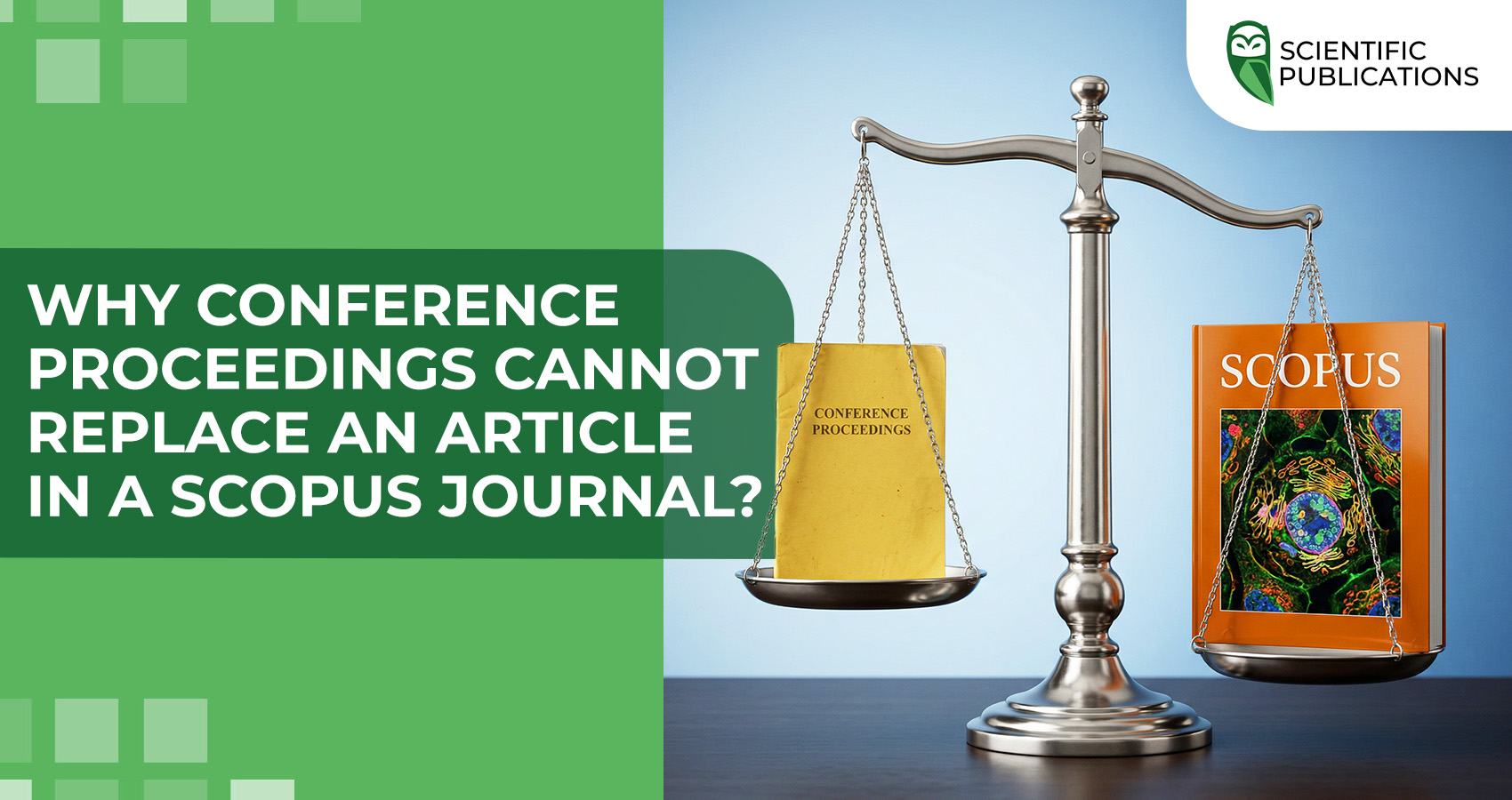
What is the difference between conference proceedings and journal articles?
Conference proceedings and journal articles are different formats of scholarly communication, even though formally both may appear in indexed databases.
A conference proceedings volume is a publication that contains papers and abstracts presented by participants in a scientific event and compiled after it has taken place. As a rule, such materials are more practice-oriented and discussion-based in nature.
Conference materials are generally intended for:
- presenting results promptly
- discussing ideas within the professional community
- testing and presenting methods
A journal publication, by contrast, is a scholarly article published in a periodical peer-reviewed journal after editorial screening and expert evaluation.
It usually reflects a more mature and complete piece of research, with a full methodological section, an extended discussion, and reliance on a broad range of sources. The length, depth of analysis, and structure of presentation are all noticeably stronger.
The difference in peer review between proceedings and journal articles
The key distinction concerns the peer review procedure. At conferences, selection often takes place within a very limited timeframe, frequently on the basis of an extended abstract or a short paper. Peer review may be limited to one or two experts from the programme committee and, in most cases, tends to be rather superficial and formal.
In Scopus-indexed journals, the process is usually multi-stage:
- Initial editorial screening of the manuscript, including a check of its relevance to the journal’s scope and requirements.
- Independent expert peer review.
- Revision of the text in response to reviewers’ comments, sometimes across several rounds.
- The final editorial decision, which is generally one of three options: accepted, revise, or rejected.
This process takes months, but it is precisely what ensures the level of quality valued by attestation commissions, grant bodies, and dissertation councils.
Risks associated with the indexation of conference proceedings
Not every conference that claims Scopus indexation actually retains it by the time the proceedings volume is published. Databases regularly review their source lists and remove series that no longer meet their standards. A researcher may face several problematic situations:
- The proceedings were indexed at the time of submission but removed before the volume was published.
- Not the entire series is indexed, but only specific volumes.
- The publication is included in Scopus, but without a quartile or citation indicators.
- The paper formally appears in the database, but is not recognised by the researcher’s institution.
Similar risks exist for peer-reviewed journals as well, but their indexation status is much easier to verify.
Why does a journal article have significant academic value?
When applying for dissertation defence, academic titles, or grant competitions, publication requirements usually distinguish between journal articles and conference materials. In a number of regulations, proceedings are counted only partially or with a reduced coefficient, and in some cases they are not counted at all.
A full journal article published in a quartile-ranked journal (Q1-Q4) fulfils more formal requirements and appears far more convincing in an academic portfolio. In addition, journal articles are cited more often, because they are easier to find through search engines and subject-specific databases.
If a researcher’s goals include dissertation defence, attestation, a grant, or international recognition, then it is far more reasonable to prioritise peer-reviewed journals. A conference publication may complement a list of works, but it cannot replace a strong publication in a reputable academic journal.
Planning a publication in Scopus? You can contact to Scientific Publications. Our specialists can help you verify the status of relevant journals and select a suitable title with regard to your subject area, deadlines, and your institution’s requirements. To receive a free consultation, fill in the form below and one of our managers will contact you shortly. Onwards to new achievements!


